
Designing High-Density Wi-Fi in a Stadium Environment: A Recent Project Completed
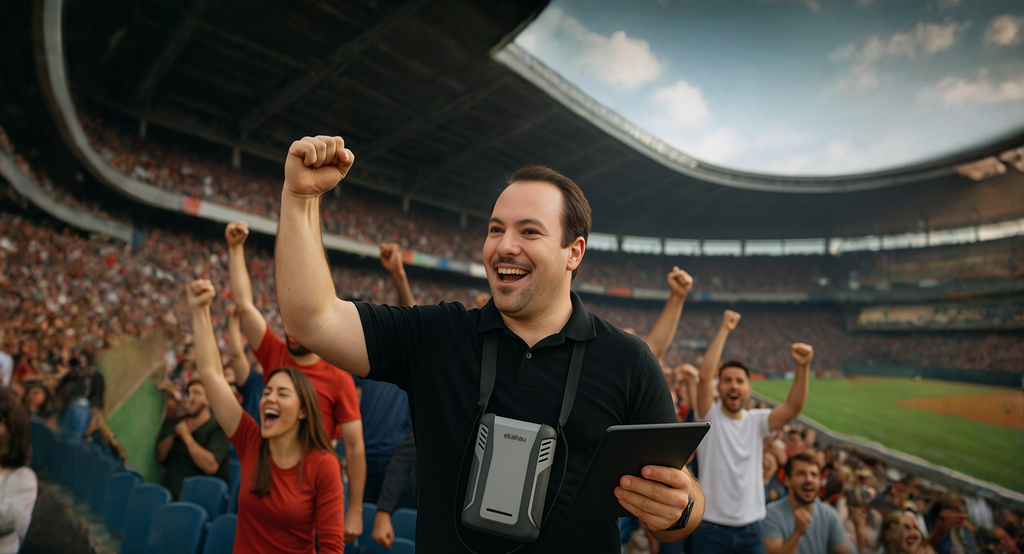
Stadium Wi-Fi is one of the toughest environments we work in as wireless engineers.
Large open spaces, rapidly shifting RF conditions, tens of thousands of mobile devices and a mix of operational needs all collide into a single design challenge.
Earlier this year I completed a stadium Wi-Fi upgrade where the initial brief sounded simple enough: improve fan connectivity, stabilise operational devices and bring the WLAN up to modern 2025 standards.
Once on site, it quickly became clear that this would require a complete redesign backed by accurate measurements, detailed modelling and proper validation to achieve the performance the venue needed.
Rather than naming the venue, I want to focus on the technical process behind it, because the lessons apply to any high-density outdoor or semi-outdoor deployment.
Understanding the Real RF Environment
Every stadium has its own RF personality.
Before proposing anything, I carried out an active survey using Ekahau and a test outdoor AP to simulate real propagation conditions.
What immediately stood out was that coverage wasn’t the main problem - capacity and hardware health were.
Two access points were completely offline, one serving a major concourse area and one feeding a central seating block, instantly creating service gaps and forcing surrounding APs to absorb the load.
That alone confirmed we weren’t dealing with a simple “tuning exercise” but a structural redesign .
Spectrally, the stadium was clean on the survey day, but anyone who has designed for sports venues knows how quickly that changes. A few thousand fans arrive, the body attenuation spikes, noise floor rises and both 5 GHz and 2.4 GHz behave very differently from an empty building.
This aligns with established RF guidance: human density, reflective surfaces and open-air propagation create unpredictable multipath and co-channel contention hotspots.
Designing for Capacity, Not Just Coverage
I built two design paths for the customer, each using different mounting strategies to suit the physical environment. This mirrors modern stadium design practice, where antenna selection and placement have a bigger impact than the AP model itself.
1. Canopy-mounted directional coverage
Placing APs along the canopy with sector antennas offered:
-
Strong line-of-sight into the seating bowl
-
Tight vertical beam control to minimise spill into neighbouring stands
-
Easy maintenance access
This approach works well when structural height allows you to “look down” into the audience and shape RF energy with predictable patterns.
2. Under-seat APs for dense seating blocks
Under-seat designs continue to gain popularity in arenas for good reason.
Mounting APs below seating, angled upward through human attenuation, offered:
-
Exceptional SNR at short distances
-
Naturally contained cells for cleaner frequency reuse
-
Reduced visual impact
Both models were simulated in Ekahau, targeting -67 dBm primary coverage and ≥25 dB SNR - values widely accepted as best practice in high-density networks .
Validating the Model with AP-on-a-Stick Testing
Because predictive modelling is only as good as the assumptions behind it, I validated both strategies using AP-on-a-Stick testing with a Sidekick 2.
This allowed me to:
-
Measure actual propagation behaviour from proposed mounting positions
-
Understand how RF interacted with canopies, railings and seating geometry
-
Identify which design delivered more stable SNR and less CCI at client height
This stage is critical in any stadium project.
Propagation angles are everything, a few degrees of tilt can be the difference between a clean, isolated cell and a coverage flood that destroys spectral efficiency.
Selecting the Optimal Strategy
The testing confirmed what many stadium engineers already know: canopy-mounted APs offer broad, predictable coverage, but under-seat APs outperform them when it comes to handling thousands of closely packed devices.
The customer chose a hybrid model that balanced operational practicality with match-day performance.
We paired this with modern RF principles:
-
Consistent 20 MHz channels in 2.4 GHz, limited use of DFS where appropriate in 5 GHz, and clean high-capacity lanes in 6 GHz for new devices
-
Mandatory data rates trimmed to remove legacy modulation overhead, improving airtime efficiency in dense crowds
-
Tight transmit-power control to prevent oversized cells and runaway co-channel contention
-
Validation against MCS rates and client throughput expectations for both infrastructure and operational handhelds
Operational Improvements Beyond RF
Two offline APs in critical locations highlighted another core requirement: ongoing WLAN health monitoring.
Stadium environments are unforgiving on hardware with weather, vibration and environmental exposure all accelerate failure.
We built a proactive monitoring framework so hardware faults can be addressed before they impact thousands of users.
Final Thoughts
Stadium Wi-Fi isn’t about “making the bars go green.”
It’s a balance of physics, design discipline and real-world validation.
Every environment behaves differently and the only way to guarantee a reliable, high-capacity network is to combine predictive modelling with measured data and the right RF strategy.
This project was a reminder of what separates everyday wireless work from true high-density engineering:
-
Design for capacity, not coverage
-
Build small, predictable RF cells
-
Validate everything - twice
-
Tune based on real user behaviour, not assumptions
Another stadium ready for the next season, built on the fundamentals that always deliver: good measurements, good modelling and good RF discipline.
No Comments