
📶 Wi-Fi 6 vs Wi-Fi 7: 🚀 Pioneering the Future of Connectivity in Diverse Sectors 🌐
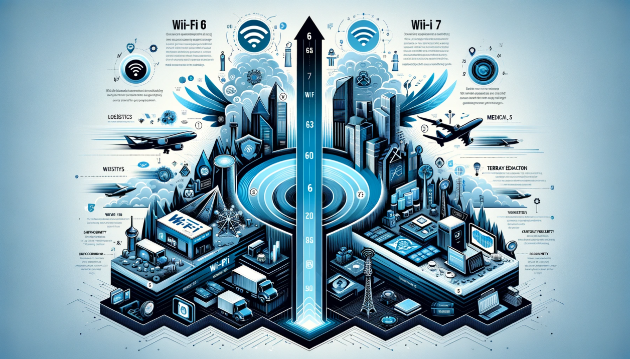
In an era where digital transformation is at its peak, Wi-Fi technology stands as a cornerstone of our day-to-day connectivity. The introduction of Wi-Fi 6 and the upcoming Wi-Fi 7 standards mark a significant leap in this landscape. This article delves deep into the nuances of both Wi-Fi 6 and Wi-Fi 7, exploring their capabilities and the profound impact they hold across various sectors like logistics, hospitality, medical, and tertiary education.
Wi-Fi 6: An Overview
Definition and Key Features
Wi-Fi 6, technically known as 802.11ax, represents a major upgrade in wireless technology. It offers increased speed, greater capacity, and superior performance, particularly in environments bustling with numerous connected devices. Key features include:
- Enhanced speed and throughput.
- Improved capacity for handling multiple devices.
- Better performance in dense environments.
Benefits in Industry
Wi-Fi 6 is not just about speed; it revolutionizes industry operations by:
- Optimizing bandwidth management.
- Extending battery life of devices through TWT (Target Wake Time).
- Strengthening network security with WPA3.
Wi-Fi 7: The Next Frontier
What Sets Wi-Fi 7 Apart
Wi-Fi 7, known as 802.11be, is poised to elevate wireless connectivity with:
- Potential for higher speeds and lower latency.
- Enhanced reliability for continuous connectivity.
Prospective Benefits
Wi-Fi 7 is expected to transform wireless communication with features like:
- QAM-4096 for increased throughput.
- Multi-Link Operation (MLO) for efficient data transmission.
- Real-Time Applications (RTA) support for time-sensitive processing.
Comparative Analysis: Wi-Fi 6 vs Wi-Fi 7
Speed and Performance
Wi-Fi 7 potentially outpaces Wi-Fi 6 with higher theoretical maximum speeds, enhancing data-intensive applications.
Latency and Efficiency
The advanced handling of network congestion and lower latency in Wi-Fi 7 is crucial for real-time data processing.
Backward Compatibility
Both standards maintain interoperability with older devices, ensuring a smoother transition.
Sector-Specific Applications and Considerations
Logistics:
- Wi-Fi 6 enhances real-time tracking and automated systems.
- Wi-Fi 7 opens doors for advanced IoT integrations and predictive analytics.
Hospitality:
- Wi-Fi 6 improves guest connectivity.
- Wi-Fi 7 could enable immersive AR/VR guest experiences.
Medical Field:
- Wi-Fi 6 supports telemedicine and medical IoT devices.
- Wi-Fi 7 promises faster, more reliable remote diagnostics.
Tertiary Education:
- Wi-Fi 6 enables connected campuses and virtual learning.
- Wi-Fi 7 supports bandwidth-intensive research and VR in education.
Challenges and Considerations
Implementing these technologies comes with challenges:
- The cost of new hardware and implementation.
- Security concerns with advanced networks.
- Managing the transition phase from Wi-Fi 6 to Wi-Fi 7.
Wi-Fi 6 and Wi-Fi 7 are pivotal in the realm of digital connectivity, offering much more than just speed enhancements. They are set to be key catalysts in transforming various sectors, paving the way for a more connected and efficient digital future. As we step into this new era, businesses and institutions need to assess their readiness for these technological advancements to stay competitive in a rapidly evolving digital world.
#WiFi6 #WiFi7 #DigitalTransformation #TechInnovation #SmartConnectivity #FutureOfNetworking
No Comments