
Why Most Wi-Fi 7 Hotel Deployments Will Disappoint Guests
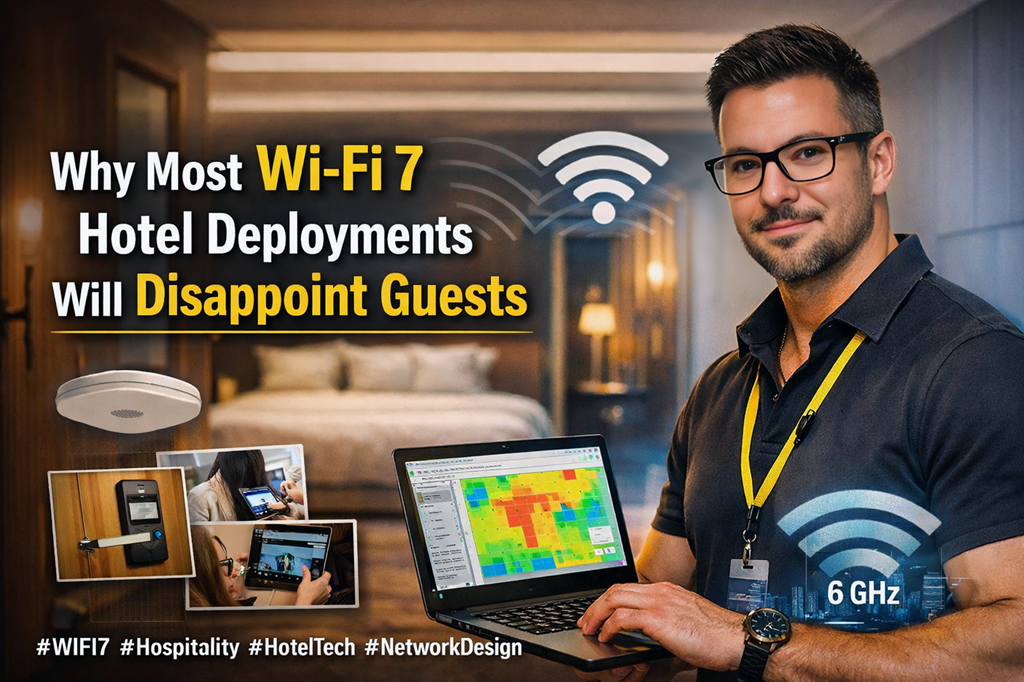
Wi-Fi 7 is arriving in hotels fast.
New access points.
6 GHz everywhere.
Big promises about speed and latency.
And yet, many hotels rolling this out in 2026 are already setting themselves up for guest complaints.
Not because Wi-Fi 7 isn’t good.
But because hotels are still repeating the same design mistakes they made with Wi-Fi 5 and Wi-Fi 6.
Hotel Wi-Fi isn’t about speed
Most hotel guests don’t care about gigabit speeds.
They care about:
- Their video call not dropping
- Streaming working in the evening
- Their phone not disconnecting when they walk to the lift
- Wi-Fi working consistently, room to room, floor to floor
That’s not a throughput problem.
That’s a design and airtime problem.
Wi-Fi 7 raises the performance ceiling, but it doesn’t fix bad cell planning, poor roaming behaviour, or oversubscribed radios.
The corridor AP mistake still hasn’t died
One of the most common hotel layouts I still see is:
- Corridor-mounted APs
- High transmit power
- “Green” coverage everywhere on a heatmap
On paper, it looks great.
In reality, every AP hears every other AP, clients cling to distant radios, and airtime disappears during peak hours.
Wi-Fi 7 doesn’t make this better.
It makes it more obvious.
Hotels need smaller, controlled cells, predictable overlap, and deliberate reuse.
If one AP can serve half a floor, it’s already too big.
6 GHz won’t save poor hotel RF
6 GHz is brilliant in hotels, when used properly.
Cleaner spectrum.
No legacy devices.
Less interference.
But in Europe especially, spectrum is limited, and channel reuse still matters.
Throwing wide channels at every floor because “6 GHz is clean” is how you burn spectrum without improving guest experience.
In most hotels, the sweet spot is:
- 6 GHz for modern guest devices
- Sensible channel widths
- Tight reuse patterns
- Clear separation between guest, staff, and IoT traffic
It’s about balance, not maximum numbers.
Legacy devices aren’t going anywhere
Hotels are full of devices that don’t care about Wi-Fi 7:
- Door locks
- TVs
- HVAC systems
- POS terminals
- Staff handhelds
Most of these live on 2.4 GHz and 5 GHz, and they’re not getting upgraded any time soon.
A good Wi-Fi 7 hotel design doesn’t try to drag everything forward. It creates space for modern clients while protecting legacy ones from contention.
That means careful SSID strategy, band steering that actually works, and not pretending the old stuff doesn’t exist.
The wired network still decides the outcome
I’m already seeing Wi-Fi 7 APs in hotels connected to:
- 1 Gbps switchports
- Marginal PoE budgets
- Old cabling reused “to save time”
At that point, the wireless upgrade is cosmetic.
Hotels need multi-gig access, proper PoE planning, and switching that can cope with sustained load during peak occupancy.
Otherwise, Wi-Fi 7 becomes a very expensive bottleneck.
Surveys and validation are non-negotiable
Hotels are some of the least forgiving RF environments:
- Dense rooms
- Mixed building materials
- Constant human attenuation
- Highly variable usage patterns
Predictive design, validation surveys, and post-deployment optimisation aren’t optional extras. They’re how you avoid guest complaints turning into bad reviews.
If you’re not measuring real-world SNR, roaming behaviour, and contention under load, you’re guessing.
And hotels can’t afford guesswork.
Final Thoughts
Wi-Fi 7 can absolutely transform hotel wireless networks.
But only when it’s treated as an engineering upgrade, not a marketing one.
The hotels that succeed with Wi-Fi 7 in 2026 will be the ones that:
- Design for capacity, not coverage
- Use 6 GHz deliberately
- Respect legacy devices
- Fix the wired network first
- Validate what they deploy
Guests won’t thank you for Wi-Fi 7.
They’ll thank you when it just works.
And that’s the real win in hospitality.
No Comments