
Mastering High-Density Wi-Fi Design in 2025: Performance, Precision, and Practicality
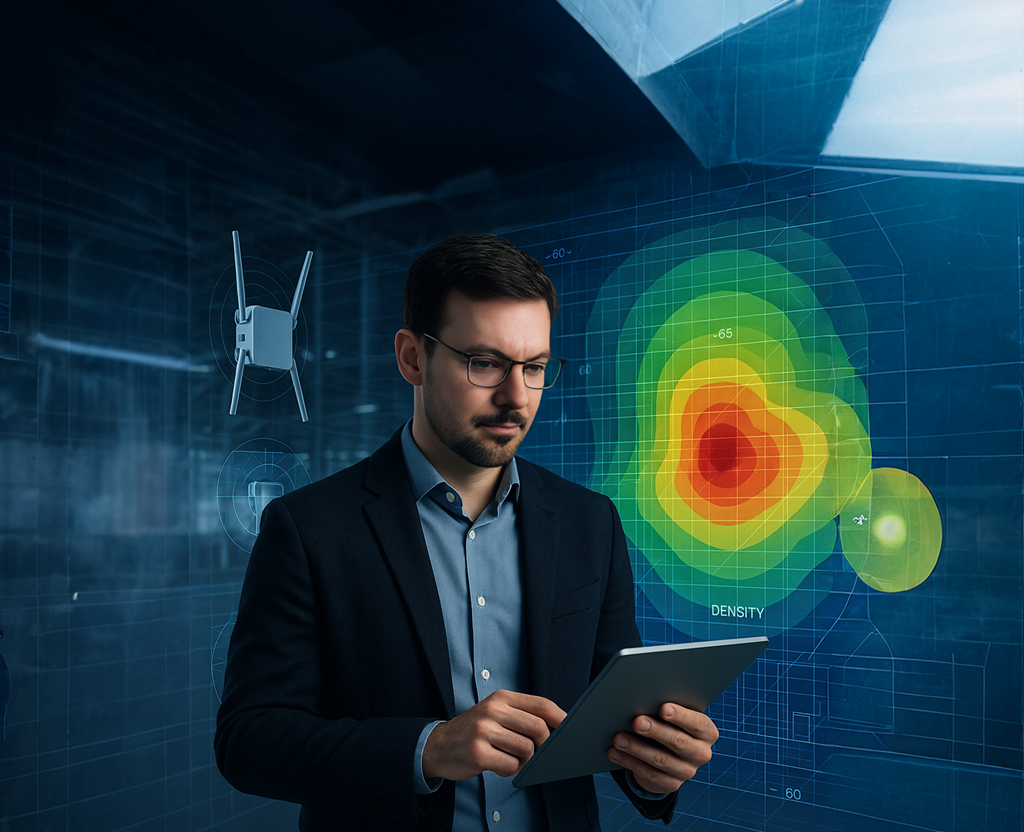
In today’s hyper-connected world, designing for high-density Wi-Fi is no longer reserved for stadiums and lecture halls, it’s a fundamental requirement across modern enterprises, logistics, healthcare, manufacturing, and education environments. As we shift further into Wi-Fi 6 and Wi-Fi 7 deployments, the real challenge lies not just in performance but in delivering consistency and resilience in the face of exponential device growth, mobility demands, and complex RF conditions.
Drawing on insights from recent design case studies and my own experience, this article explores the key principles and considerations for building reliable high-density wireless networks in 2025.
Understanding the Nature of High-Density Design
High-density isn’t defined by square footage, it's about the number of devices competing for airtime in a confined RF space. Think:
-
Auditoriums, conference spaces, and schools
-
Hospitals with Wi-Fi-enabled telemetry and tablets
-
Manufacturing sites with AGVs, smart tools, and OT systems
-
Warehouses with handhelds, scanners, and roaming VoIP devices
In all these environments, coverage is easy. Capacity and interference mitigation are the real challenges.
Common Pitfalls in High-Density Wi-Fi
Across numerous enterprise rollouts, I’ve consistently observed a few recurring issues:
-
Excessive Transmit Power: Overpowering APs might look good in Ekahau with “green everywhere,” but it creates excessive contention. Remember: green doesn’t equal good.
-
Omni Antennas in Poorly Reflected Environments: In RF-rich or reflective spaces (like metal-dense warehouses), omnis increase co-channel interference.
-
Overuse of Wide Channels: Bonding 80/160 MHz in congested areas often backfires. Sometimes 20 MHz is still king in high-density design.
These decisions often stem from the misconception that “more signal equals better performance.” In reality, it’s about signal control, not signal strength.
Strategic Antenna Choices and Mounting
One of the most powerful tools in a high-density engineer’s toolbox is directional antennas. In environments such as automotive manufacturing or retail show floors, shifting to directional 60x60° or 90x90° patterns can dramatically reduce co-channel contention and help sculpt signal propagation to avoid overlap.
Smart mounting strategies, like using custom brackets on columns or concrete pillars, allow for precise RF shaping and improved line-of-sight to client devices. We’ve seen cases where replacing ceiling-mounted omnis with strategically placed directional APs completely resolved mobility and interference issues.
Making Use of Wi-Fi 6/6E/7 Features Intelligently
Wi-Fi 6 and 6E brought OFDMA, BSS coloring, and target wake time, features designed for dense environments.
Wi-Fi 7 expands this further with:
-
Multi-Link Operation (MLO) for reduced latency and increased resiliency
-
6 GHz channel availability for cleaner spectrum
-
High throughput modulation (4K-QAM) to push performance further (when SNR allows)
But the success of these features is entirely dependent on accurate planning. You can’t simply deploy Wi-Fi 7 APs and expect magic, design remains critical.
Design and Validation is Non-Negotiable
Whether using Ekahau AI Pro, Sidekick 2, or Catalyst-Center/Juniper Mist dashboards, validation is essential.
This includes:
-
Primary and secondary coverage heatmaps
-
SNR and interference analysis
-
Validation of minimum basic rates
-
Understanding how NDP (Neighbor Discovery Protocol) traffic travels
At large events like Cisco Live EU, thousands of clients and APs coexist because of deliberate low transmit power (often 5–11 dBm), tight RF profiles, and real-time telemetry-based tuning.
Best Practice Summary
Here’s my distilled checklist when building for high density:
✅ Use directional antennas where possible (internal directional or external)
✅ Keep transmit power low-optimize for capacity, not coverage
✅ Limit channel widths appropriately (20 or 40 MHz for dense deployments)
✅ Reduce minimum data rates to 12 Mbps or higher (avoid legacy 1–2 Mbps)
✅ Leverage 5 GHz and 6 GHz (if supported) for primary SSIDs
✅ Limit SSID count to reduce beacon overhead (ideally ≤3 per band)
✅ Conduct proper validation surveys post-deployment
Final Thoughts
High-density Wi-Fi is no longer an exception, it’s the rule in enterprise design. Success hinges on your ability to balance client behavior, RF conditions, and access point capability through intelligent design choices. Off-the-shelf, one-size-fits-all deployments fail in complex RF environments.
Whether you’re building a network for a hospital ward, an airport lounge, or a warehouse filled with AMRs, remember: performance starts with design, not with the AP spec sheet.
If you’re facing a high-density wireless challenge or just want to discuss best practices, feel free to connect, always happy to talk RF.
#WiFiDesign #WiFi7 #HighDensityWiFi #WirelessEngineering #Ekahau #Cisco #JuniperMist #RFDesign #WLANArchitecture #WiFiOptimization #WiFiSurvey #WirelessForWarehousing #WirelessForEducation #WirelessForHealthcare
No Comments