
Why Hospital Wi-Fi Is No Longer “Just IT Infrastructure”
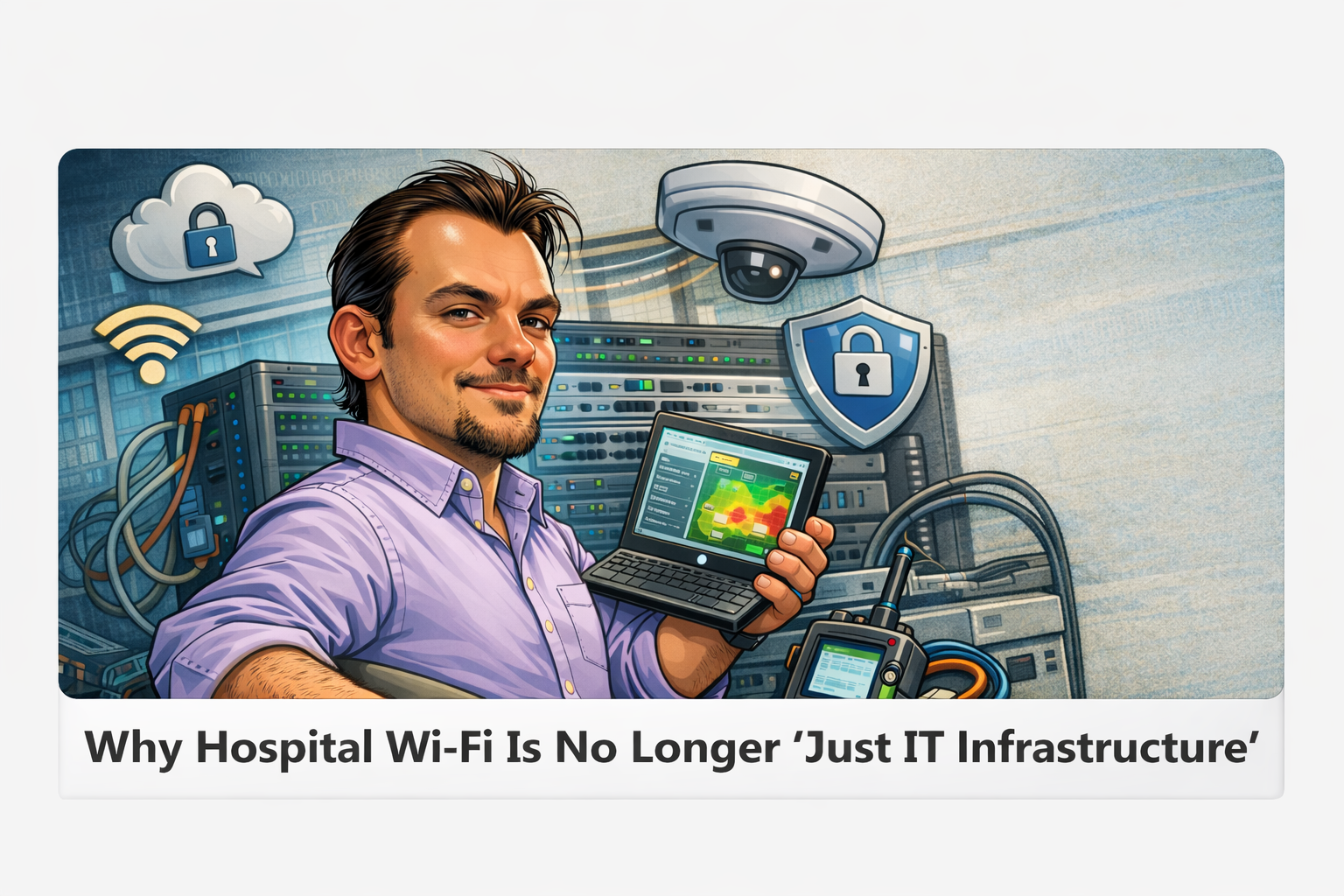
In healthcare, Wi-Fi is no longer a convenience layer sitting quietly in the background.
It is clinical infrastructure.
If the network fails, workflows break. If workflows break, patient safety is impacted. That changes how we should think about wireless design in hospitals entirely.
I still see Wi-Fi treated as a facilities problem. Something to “cover the building” and move on. In a hospital, that mindset doesn’t survive first contact with reality.
Hospitals Are Always On, and Wi-Fi Has to Be Too
Hospitals don’t shut down at night.
There is no safe maintenance window.
There is no tolerance for disruption.
That alone forces a different design approach. Dynamic RF behaviours that might be acceptable elsewhere become risky. Channel changes, reboots, or power adjustments can’t interrupt telemetry, medication systems, or staff communications.
This is why hospital Wi-Fi needs deliberate RF planning, controlled cell sizes, and predictable behaviour, not best-effort automation.
A high-performing network in healthcare isn’t about speed. It’s about reliability, determinism, and trust.
Clinical Devices Don’t Behave Like Normal Clients
Healthcare environments carry one of the most fragmented client landscapes you’ll ever see.
On the same network you’ll find:
-
Legacy medical devices locked to old chipsets
-
Voice and communication badges that roam aggressively
-
Workstations on wheels moving continuously
-
Real-time location tracking tags
-
High-density patient and visitor devices
Many of these devices actively conflict with modern RF design best practices. Some prohibit certain 5 GHz channels. Others demand extremely fast roaming. Some are intolerant of retries or packet loss.
You can’t design Wi-Fi for hospitals by optimising for the newest device. You have to design for the most fragile one.
Physical Barriers You Can’t See Will Break Your Design
Hospitals are RF-hostile by default.
Lead-lined walls in radiology.
Stainless steel surfaces.
Unmapped reinforcement plates behind walls.
Floor plans lie.
A predictive model is only a starting point in healthcare. Without real-world validation, you’re guessing. And guessing in a hospital is expensive.
Once an AP is installed in a sterile area, moving it isn’t trivial. Infection control procedures, sealed environments, and clinical schedules mean mistakes cost time, money, and credibility.
This is why validation surveys and AP-on-a-stick testing are not “nice to have” in healthcare. They are risk management tools.
Patient Experience Is Now Part of Clinical Quality
Connectivity is no longer separated from care quality.
Patients expect to video call family, stream content, and stay connected, even during long admissions. Families expect seamless connectivity in waiting areas and outdoor spaces.
But here’s the challenge: patient traffic is bursty and unpredictable.
Visiting hours, waiting rooms, and emergency departments can see sudden spikes in device count that rival event venues. If your design has no headroom, performance collapses exactly when stress levels are already high.
Good healthcare Wi-Fi designs assume peak load is normal, not exceptional.
Security Isn’t Optional When Lives Are Involved
Hospitals transmit some of the most sensitive data that exists.
That means Wi-Fi security failures are not just IT incidents. They are regulatory, reputational, and potentially life-impacting events.
Rogue access points, weak encryption, missing management frame protection, and shadow IT are common symptoms of poorly performing networks. When staff lose trust in official Wi-Fi, they work around it.
A reliable network is a more secure network. When Wi-Fi works properly, people stop trying to bypass it.
Validation and Continuous Optimisation Are Where Success Lives
The biggest gap I see in healthcare Wi-Fi projects is what happens after installation.
APs go up.
SSIDs broadcast.
Everyone moves on.
Without post-deployment validation, you have no proof the network supports the devices it was designed for. Without continuous optimisation, RF conditions drift as equipment moves, wards change purpose, and new devices are added.
Healthcare environments evolve constantly.
Wi-Fi designs must evolve with them.
Final Thoughts
Hospital Wi-Fi is not about coverage maps or access point counts.
It’s about enabling care, protecting data, and removing friction from clinical workflows.
The teams that get this right stop thinking like network installers and start thinking like clinical enablers.
They design carefully, validate relentlessly and optimise continuously.
But when that happens, Wi-Fi stops being the thing everyone complains about and starts being the thing no one notices.
Which, in healthcare, is exactly how it should be.
No Comments