Wi-Fi 7 in Stadiums: What Actually Matters in the Real World
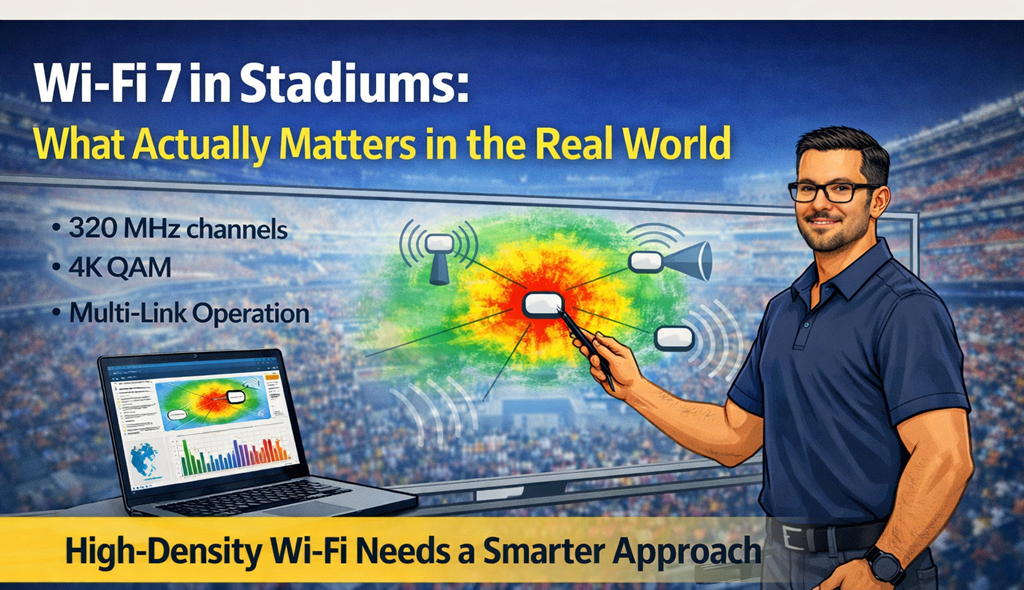
When Wi-Fi 7 started gaining attention, the conversation quickly focused on the headline features.
320 MHz channels
4K QAM
Multi-Link Operation
On paper, it all looks like a major leap forward.
But if you have ever designed or troubleshot Wi-Fi in a stadium, arena, or large public venue, you will already know something important.
What looks impressive on a datasheet does not always translate into real-world performance.
And that is where things get interesting.
High-Density Wi-Fi Is a Different Problem
Designing Wi-Fi for a stadium is not just scaling up a normal deployment.
It is a completely different RF challenge.
You are dealing with:
-
Tens of thousands of devices
-
Heavy airtime contention
-
A wide mix of client capabilities
-
Constant movement and shifting density
-
Critical services like ticketing, payments, and live content
At this scale, success is not about peak throughput.
It is about predictability, efficiency, and control of the RF environment.
Wi-Fi 7: What Actually Moves the Needle
Let’s focus on what really matters in large public venues.
1. Better Radios
This is the part that gets overlooked.
Wi-Fi 7 radios are simply more efficient:
-
Better receive sensitivity
-
Smarter scheduling
-
Improved airtime usage
In a stadium, airtime is the most valuable resource.
You are not trying to make one device fast.
You are trying to make thousands of devices work at the same time.
2. Multi-Link Operation (MLO)
MLO is one of the most talked about features.
The idea is straightforward:
-
Clients can use multiple bands at the same time
-
Traffic can be spread more effectively
In practice today:
-
Client support is still limited
-
Behaviour can be inconsistent
-
It adds complexity to an already complex environment
There is real potential here, but it is not something most high-density designs rely on yet.
3. Wider Channels (320 MHz)
This is where expectations and reality often do not align.
In high-density design:
-
Spectrum is limited
-
Channel reuse is critical
-
Interference needs tight control
Using wider channels reduces reuse and increases contention.
Most large venue designs still rely on:
-
20 MHz or 40 MHz channels
-
Careful channel planning
-
Controlled cell sizes
Wider channels work well in low-density environments.
They are not a good fit for stadiums.
4. 4K QAM
Higher modulation can increase peak speeds.
But it requires:
-
Very strong signal
-
Clean RF conditions
-
Close proximity to the access point
That is not typical in a stadium.
Most clients will not operate at these levels consistently, so it does not drive design decisions.
5. OFDMA and MU-MIMO Enhancements
This is where Wi-Fi 7 starts to show real value.
Improvements here mean:
-
Better airtime efficiency
-
More consistent performance under load
-
Improved handling of many active clients
This aligns directly with the challenges of high-density environments.
The Part That Still Gets Missed
Even with Wi-Fi 7, the fundamentals have not changed.
You can deploy the latest hardware and still end up with poor performance if the design is wrong.
Common issues still include:
-
Poor access point placement
-
Incorrect antenna selection
-
Overlapping coverage
-
Lack of RF containment
-
Ignoring how clients actually behave
These are the things that break networks, not the standard itself.
Design Still Wins
Strong large venue deployments all follow the same principles:
-
Start with RF design, not hardware
-
Control cell size carefully
-
Use directional antennas where it makes sense
-
Design for capacity instead of just coverage
-
Validate in the real world
Predictive models are useful, but they do not fully account for:
-
Human density
-
Device variability
-
Environmental changes
Validation and optimisation are just as important as the initial design.
Is Wi-Fi 7 Worth It for Stadiums
Yes, but not for the reasons people expect.
It is not about:
-
Wider channels
-
Maximum throughput
-
Marketing features
It is about:
-
Better efficiency
-
Improved airtime management
-
Incremental gains that scale across thousands of users
Wi-Fi 7 does not replace good design.
It amplifies it.
Final Thoughts
Wi-Fi 7 is a solid step forward.
But in large public venues, it is not a silver bullet.
The engineers who will get the most out of it are the ones who:
-
Understand RF fundamentals
-
Design for real-world conditions
-
Validate properly
-
Focus on user experience
Because in a stadium full of people, no one cares what standard you are running.
They just care that it works.