Designing Wi-Fi for Industrial Environments: Where OT Breaks Traditional IT Thinking
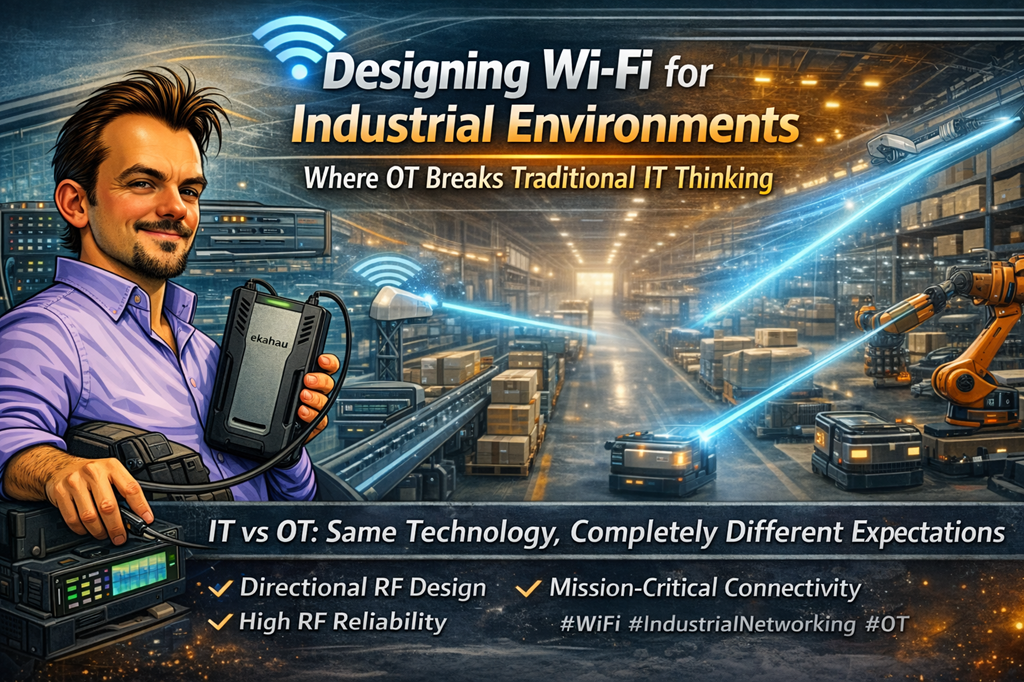
For years, most Wi-Fi designs have followed a familiar pattern.
Design for coverage.
Add capacity where needed.
Tune it after deployment.
That approach works reasonably well in traditional IT environments.
It doesn’t work in industrial.
Because in OT environments, Wi-Fi isn’t just connectivity.
It’s control.
And when control depends on wireless, the tolerance for failure drops to zero.
IT vs OT: Same Technology, Completely Different Expectations
Before going further, it’s worth being clear on one thing.
OT stands for Operational Technology.
This refers to the systems and networks that monitor and control physical processes.
Think:
- Manufacturing lines
- Robotics and automation systems
- Industrial control systems
- Warehouse automation like conveyors, cranes, and AGVs
This is very different from IT, which is focused on users, applications, and data.
In OT, the network isn’t just supporting the business.
It’s directly controlling how the business operates.
One of the biggest mistakes I still see is treating industrial WLANs like corporate office deployments.
On the surface, it’s still Wi-Fi. Same standards, same access points, same spectrum.
But the requirements are fundamentally different.
In IT environments, we design around users.
In OT environments, we design around machines and processes.
That shift changes everything.
- IT devices are unpredictable. OT devices are controlled and known
- IT networks tolerate retries and latency. OT networks often cannot
- IT refresh cycles are measured in years. OT lifecycles stretch well beyond a decade
In a warehouse or manufacturing plant, you’re not just supporting email and Teams calls.
You’re supporting:
- Robotics and automation systems
- Real-time telemetry and control systems
- Safety mechanisms that depend on continuous communication
And when that communication drops, it’s not a user complaint.
It’s a production stop. Or worse.
This is why modern industrial Wi-Fi is treated as a mission-critical backbone for operations, not just a convenience layer .
The RF Environment: Where Theory Meets Reality
Industrial environments are some of the most unforgiving RF spaces you’ll ever design in.
You’re dealing with:
- Metal racking reflecting and scattering RF
- Concrete and dense materials absorbing signal
- Constantly changing layouts as inventory moves
- High ceilings that break traditional cell design
What looks clean in a predictive model rarely stays that way in production.
Even something as simple as a fully stocked aisle vs an empty one can completely change propagation characteristics.
And then there’s the noise floor.
Heavy machinery, motors, and even lighting systems introduce electromagnetic interference that raises the noise floor and reduces SNR. When SNR drops, everything slows down .
This is why designing purely for RSSI in industrial environments is a mistake.
You design for:
- SNR
- Consistency
- Predictability
Fixed Path Design: Engineering RF Instead of Hoping for It
This is where industrial Wi-Fi starts to get interesting.
Unlike IT environments, OT often gives you something valuable:
Predictability.
Machines don’t wander randomly. They follow defined paths.
And that allows you to engineer RF with intent.
Directional Coverage in “Steel Canyons”
Warehouse aisles behave like waveguides.
Instead of fighting that, you can use it.
Directional antennas aligned down aisles allow you to:
- Control cell boundaries
- Reduce co-channel interference
- Deliver consistent signal along movement paths
Midspan and Bidirectional Design
In long runs, especially where work happens mid-aisle, relying on edge coverage isn’t enough.
You need to design for where the operation actually occurs.
That often means:
- Midspan antenna placement
- Bidirectional coverage patterns
- Controlled overlap for roaming stability
Leaky Feeder (R-Coax)
In highly controlled environments, R-Coax becomes a powerful tool.
Instead of traditional cells, you create a continuous RF zone.
When done properly, clients operate within a predictable RF envelope, often just inches from the radiating cable.
This removes a lot of the variability that traditional Wi-Fi introduces.
Omnidirectional Still Has a Place
Not everything is linear.
As soon as movement becomes multi-directional, you need to shift back to more traditional coverage models.
But even then, placement is driven by process, not aesthetics.
Designing for Roaming, Not Just Coverage
In industrial environments, roaming isn’t a nice-to-have.
It’s fundamental.
Devices move constantly:
- Forklifts
- AGVs and AMRs
- Crane systems
- Handheld scanners
If roaming isn’t clean, the system breaks.
This is where many deployments fail.
Because coverage alone doesn’t guarantee:
- Fast roaming
- Stable sessions
- Low latency transitions
The network has to be engineered for movement.
That means:
- Predictable cell overlap
- Consistent signal levels
- Clean RF boundaries
Because even short interruptions can disrupt operations or cause system desynchronisation .
The Reality of Client Devices: Design for the Worst, Not the Best
One of the biggest challenges in OT is the client landscape.
You’re not dealing with modern smartphones.
You’re dealing with:
- Legacy barcode scanners
- Vehicle-mounted terminals
- Industrial controllers
- Robotics systems
And here’s the reality.
The least capable device is often the most important.
Older scanners with poor radios and limited roaming capability still sit at the heart of many operations. If they fail, the entire workflow stops .
So you don’t design for peak performance.
You design for:
- Lowest common denominator RF
- Stable connectivity at lower data rates
- Predictable behaviour under movement
Redundancy in Industrial Wi-Fi: When One Path Isn’t Enough
In IT, packet loss is annoying.
In OT, packet loss can trigger a shutdown.
That’s why redundancy becomes a design requirement, not an afterthought.
Technologies like Parallel Redundancy Protocol (PRP) take this further.
Instead of relying on a single path, traffic is duplicated and sent across multiple independent paths.
The receiving system accepts the first packet and discards the duplicate.
From a wireless perspective, this means designing:
- Multiple RF paths
- Independent coverage strategies
- True path diversity
It’s not about making Wi-Fi faster.
It’s about making it predictable under failure.
The Hidden Challenge: Industrial Environments Never Stay Static
Unlike offices, industrial environments constantly evolve.
- Inventory levels change daily
- Machinery moves or gets replaced
- New systems get introduced
- RF conditions shift over time
What worked six months ago might not work today.
This is why validation isn’t a one-time exercise.
It’s an ongoing process.
You design, you validate, and you continuously adapt.
Final Thoughts
Industrial Wi-Fi forces you to think differently.
You stop designing for coverage maps and start designing for behaviour.
You stop focusing on peak throughput and start focusing on consistency.
And most importantly, you stop treating Wi-Fi as a convenience.
Because in OT environments, it isn’t.
It’s part of the control system.
And if the control system fails, everything else follows.