Designing Wi-Fi for Hospitality: Where Experience Meets Engineering
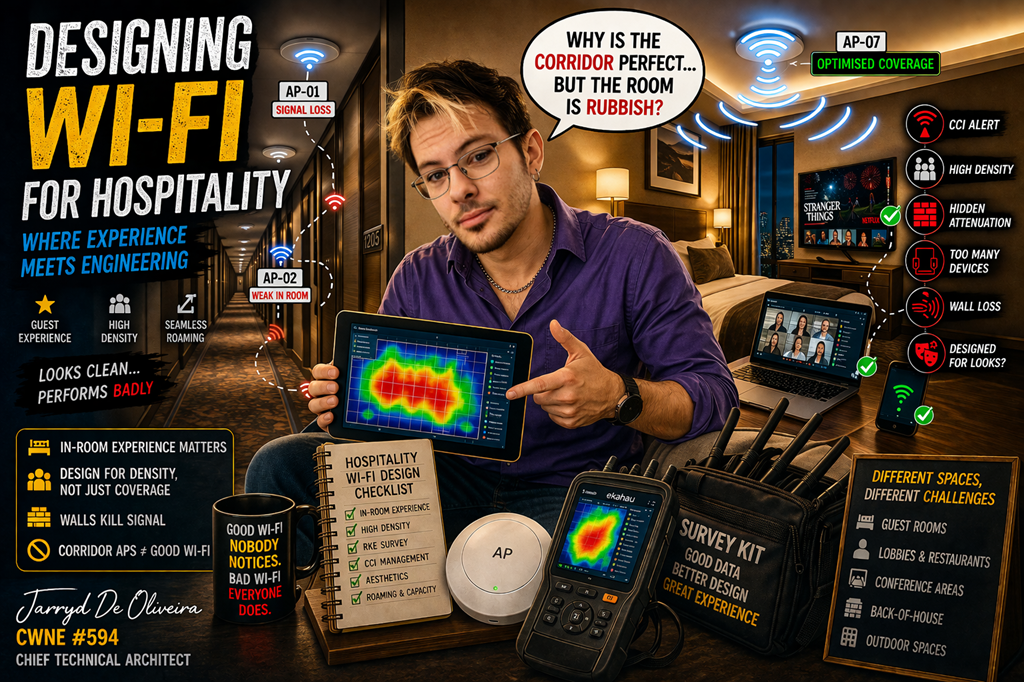
For years, Wi-Fi in hotels was treated as a “nice to have.”
That’s not the case anymore.
Today, Wi-Fi is part of the guest experience.
If it doesn’t work well, guests notice. And they remember.
In many cases, it’s one of the first things people check when they walk into a room.
At that point, Wi-Fi stops being IT.
It becomes part of the product.
Wi-Fi Is Now a Core Utility
In hospitality, Wi-Fi sits alongside power, water, and heating.
Guests expect it to just work. Everywhere.
Rooms
Lobbies
Restaurants
Conference areas
Outdoor spaces
And not just basic connectivity. High performance.
Streaming, video calls, gaming, mobile check-in, digital keys… it all relies on the network being stable and fast.
Get it right, and it improves guest satisfaction and operations.
Get it wrong, and it shows up in reviews almost immediately.
The Challenge: Hotels Are Not Easy RF Environments
On paper, hotels look simple.
In reality, they are some of the most challenging wireless environments to design.
You’re dealing with:
- Dense, repetitive room layouts
- Thick walls and heavy materials
- High user density
- Constantly changing devices
- A mix of guest and operational traffic
And all of that sits inside buildings that were never designed with RF in mind.
Guest Rooms: Where Most Designs Go Wrong
This is where I still see the biggest mistakes.
Corridor-based designs.
They look clean. They’re easy to install. They keep APs out of sight.
But they rarely deliver good in-room performance.
Why?
Because the signal has to go through:
- Concrete
- Tiles
- Insulation
- Plumbing
- Furniture
By the time it reaches the client, it’s weak and inconsistent.
On top of that, you often get the “hallway waveguide” effect. APs hear each other, power gets reduced, and coverage inside rooms drops even further.
If you care about user experience, you design for the room.
Not the corridor.
Density: The Silent Killer
Hotels don’t just have users.
They have lots of devices per user.
A single room can easily have:
- Phones
- Laptops
- Tablets
- Smart TVs
- IoT devices
Multiply that across a full floor or building, and density becomes the real challenge.
It’s not about coverage anymore.
It’s about airtime.
Without proper design, the network becomes congested very quickly, especially during peak hours.
Not All Spaces Are Equal
One of the key things in hospitality design is understanding that every area behaves differently.
You’re not designing one network.
You’re designing multiple RF environments inside the same building.
Guest Floors
- High attenuation
- Repetitive layouts
- Requires consistent, predictable coverage
Lobbies and Restaurants
- Open spaces
- High ceilings
- Reflective materials like glass and marble
Conference Areas
- High density
- High throughput
- Temporary changes (walls, staging, AV gear)
Back-of-House
- Harsh environments
- Metal, equipment, and interference
- Still mission-critical for operations
Outdoor Spaces
- Coverage extension
- Roaming continuity
- Environmental challenges
Each one needs a different approach.
RF Challenges You Can’t Ignore
Hospitality environments introduce a few consistent RF problems:
Co-channel interference
APs are often too close together, especially across rooms and floors.
Signal loss into rooms
This is the biggest issue with poor placement strategies.
All of this leads to inconsistent performance if not properly designed and validated.
The Aesthetic Problem
This is where engineering meets reality.
Hotels care about how things look.
That means:
From a design point of view, these are rarely ideal placements.
But they are often required.
So the job becomes balancing performance with aesthetics, without compromising the user experience.
One Network, Multiple Roles
Hotel Wi-Fi doesn’t just serve guests.
It also supports:
- Staff devices
- Operational systems
- IoT (locks, sensors, automation)
That adds pressure on:
- Capacity
- Segmentation
- Security
A failure is no longer just a guest issue.
It impacts operations as well.
What Good Looks Like
Good hospitality Wi-Fi doesn’t happen by accident.
It comes down to a few fundamentals:
- Design for the client, not the floor plan
- Prioritise in-room experience
- Plan for density, not just coverage
- Validate everything with a proper survey
- Understand how each space behaves
- Balance aesthetics without breaking RF
And most importantly…
Stop treating hospitality like a standard office deployment.
Because it isn’t.
Final Thoughts
Hospitality Wi-Fi sits in a unique space.
It’s not purely IT.
It’s not purely user experience.
It’s both.
And when it’s done right, nobody notices.
When it’s done badly, everyone does.
That’s the difference.