Designing Reliable and Secure Wireless Networks for Hospitals: Lessons from the Field
https://www.linkedin.com/feed/update/urn:li:activity:7382248525025157120/
Hospital wireless networks aren’t just about connectivity, they’re about life-critical reliability. From real-time telemetry and nurse call systems to IoMT (Internet of Medical Things) devices and mobile EHR carts, wireless in healthcare has become a fundamental layer of patient care. Designing it well means balancing performance, security and resilience under some of the most demanding conditions an RF environment can present.
Understanding the Hospital RF Environment
Hospitals are RF-hostile by nature.
Thick concrete walls, lead-lined imaging rooms and a mix of medical and consumer devices operating in the same bands all contribute to a challenging design.
Add to that a 24/7 operational requirement and zero tolerance for downtime and it’s clear that healthcare Wi-Fi design isn’t business as usual.
Key design considerations include:
-
Interference Management: Many medical devices still rely on 2.4 GHz for compatibility, but that band is heavily congested. Prioritize 5 GHz for performance and leverage 6 GHz where regulations and device support allow.
-
Spectrum Discipline: Use 20 MHz channel widths in 2.4 GHz, 40 MHz in moderate-density 5 GHz areas and expand to 80 MHz only where spectrum reuse can be controlled without co-channel contention.
-
Antenna Selection: Directional antennas in long wards or diagnostic corridors help shape coverage and reduce overlap. Omni antennas work better in open wards and waiting areas where mobility is high.
Coverage, Capacity, and Device Behavior
In healthcare, capacity planning is as important as coverage.
While a warehouse or office network might focus on throughput, hospitals demand predictable performance under load.
Telemetry monitors, infusion pumps, tablets and VoIP handsets all have different roaming and latency tolerances. Set minimum basic rates around 12 Mbps (or higher for dense areas) and avoid legacy rates (1, 2, 5.5, 11 Mbps) that waste airtime. Disable 802.11b support entirely and ensure quality of service (QoS/WMM) is enforced to prioritize voice and telemetry traffic.
Client behavior validation is critical. Don’t assume all devices roam gracefully, test and profile each medical vendor’s hardware in a controlled lab before deploying live. In many cases, medical devices are built on older chipsets that behave unpredictably with band steering or OFDMA.
Build policies that favor stability over theoretical efficiency.
Switching and Infrastructure Design
Beneath every resilient wireless network lies a robust wired foundation.
Hospitals often run redundant PoE switches across multiple distribution zones, each supplying critical APs, nurse stations and medical rooms.
A few switching best practices to ensure uptime and performance:
-
PoE Planning: Many Wi-Fi 6E and Wi-Fi 7 access points require 802.3bt (up to 51 W). Confirm your switching infrastructure supports full power delivery without oversubscription.
-
Segmentation: Separate clinical systems, guest networks, building management and IoMT traffic using dedicated VLANs. This reduces broadcast domains and isolates sensitive data.
-
Redundancy: Stack or MLAG distribution switches for failover and use redundant fiber uplinks back to the core. In hospitals, single points of failure are unacceptable.
-
Monitoring: Integrate switch telemetry into NMS tools to alert on PoE draw, interface errors and latency spikes that can affect wireless performance.
Security: Protecting Patients and Data
Healthcare Wi-Fi carries sensitive patient data governed by GDPR and other regulations. Wireless design must enforce confidentiality, integrity and availability without introducing friction for medical staff.
-
Authentication: Use WPA3-Enterprise with certificate-based EAP-TLS for hospital-owned devices. For BYOD (doctors, consultants), implement a secure onboarding workflow through tools like Cloudpath or ClearPass.
-
Network Isolation: Enable client isolation on guest SSIDs to prevent lateral movement. Use dynamic VLAN assignment to keep each session contained.
-
Encryption: Avoid TKIP/WEP entirely. Use AES-CCMP or GCMP and ensure management frame protection (802.11w) is mandatory.
-
Device Segmentation: Where possible, separate IoMT and patient-care devices from standard hospital workstations via firewalled VLANs with explicit Layer 3 rules.
-
Visibility: Employ network access control (NAC) and anomaly detection systems to identify rogue APs or unauthorized associations in real time.
Validation and Lifecycle Management
A hospital network design isn’t “set and forget.”
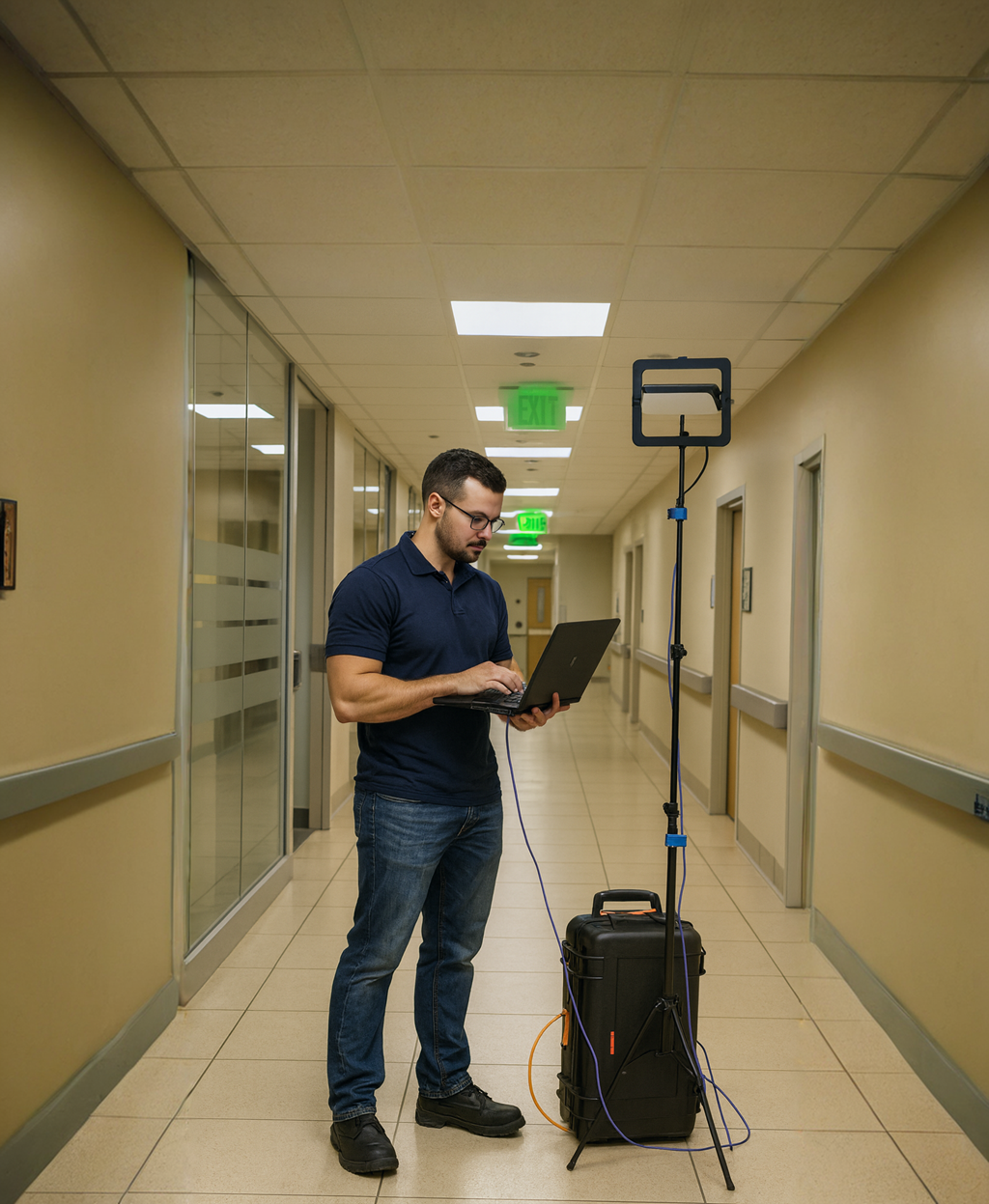
It evolves continuously with new wings, new devices and new security requirements appear regularly. Every installation should include post-deployment validation using professional survey tools to confirm signal-to-noise ratios (SNR), roaming behavior and airtime utilization.
Establish a design lifecycle similar to RIBA’s project stages, define, design, implement, validate, and optimize. Regularly revisit RF tuning, channel reuse, and power levels as the device landscape changes.
In high-density areas like surgical wards or waiting rooms, measure real-world channel utilization and noise floors to fine-tune your RF plan.
Final Thoughts
Designing wireless networks for hospitals demands a balance between engineering precision and operational pragmatism.
Every access point, switch and VLAN carries the weight of patient care behind it.
The most successful hospital networks are the ones that quietly work, invisible, stable and secure. Achieving that requires not just technical knowledge but an understanding of how clinicians, devices, and data truly interact in real-world environments.
By applying disciplined RF planning, structured switching design and uncompromising security principles, you don’t just build Wi-Fi, you build trust in the network that helps save lives.